Animal Cruelty Accountability Measures That Work
Published by Nevada Animal Advocates
When an animal abuse case makes headlines, public outrage is immediate. Then the cycle often repeats: a brief arrest, an unclear court outcome, little public visibility, and few lasting consequences. That gap is exactly why animal cruelty accountability measures matter. If abuse is treated as a private lapse instead of a public safety issue, the system leaves animals, and communities, exposed.
Accountability is not the same as awareness. Most people already agree that cruelty is wrong. The harder question is what happens after a report is made, a charge is filed, or a conviction is entered. Real accountability requires systems that make abuse visible, enforceable, and difficult to repeat.
What animal cruelty accountability measures actually mean
The phrase can sound bureaucratic, but the idea is simple. Animal cruelty accountability measures are the legal, administrative, and public tools used to make sure abuse has consequences. They are designed to do more than punish one offender in one case. They create a framework that increases detection, improves enforcement, and reduces the chance that known abusers can offend again without scrutiny.
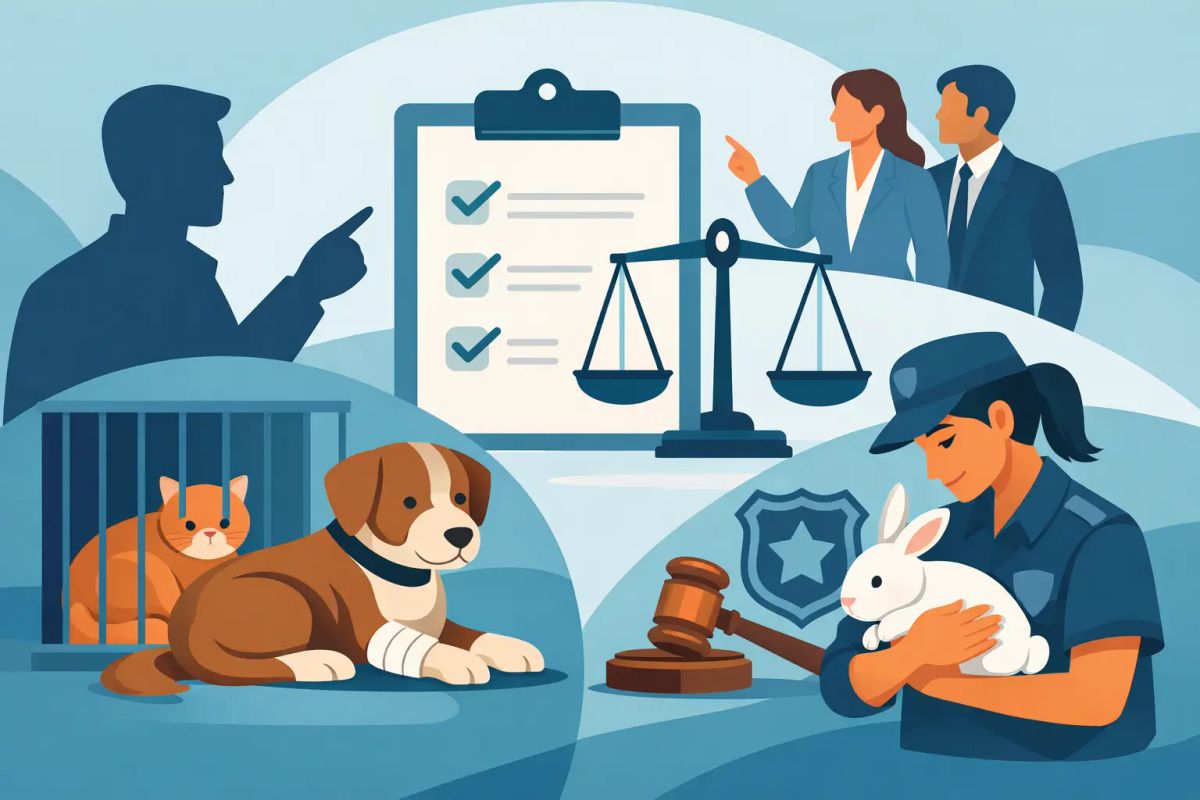
That framework can include criminal penalties, ownership bans, mandatory psychological evaluation, cross-reporting requirements, public registries, stronger standards for seizure and forfeiture, and better tracking of repeat offenders. Some measures operate inside the justice system. Others depend on public transparency and civic oversight.
The strongest approach uses both. Criminal law matters, but criminal law alone often falls short when cases are pled down, records are hard to find, or agencies are not required to share information. A closed system protects process, but it can also hide patterns.
Why weak enforcement keeps cruelty in circulation
Animal cruelty is still too often minimized. In practice, that means inconsistent charging, light plea deals, delayed case processing, and penalties that do not reflect the seriousness of the harm. It also means many offenders face no meaningful barrier to obtaining or possessing more animals later.
That failure has consequences beyond the immediate victim. Abuse can signal broader violence, household instability, or ongoing neglect that affects multiple animals over time. When institutions treat cruelty as minor, they invite repeat harm.
This is where public policy matters. A law on paper is not enough if officers lack training, prosecutors are overloaded, judges lack clear sentencing guidance, or agencies do not coordinate. Accountability breaks down at the points where responsibility becomes optional.
The animal cruelty accountability measures with the most impact
Not every reform carries the same weight. Some are symbolic. Others change behavior because they increase visibility and raise the cost of reoffending.
Public offender registries
A statewide animal abuse registry is one of the clearest accountability tools available. It gives the public, shelters, rescues, landlords, employers in animal-facing fields, and community members access to verified information about convicted offenders. That kind of visibility changes the landscape.
Registries are not a cure-all. Their value depends on legal design, data accuracy, eligibility standards, and how often records are updated. But when structured carefully, they serve a practical public-interest purpose: they make it harder for a known abuser to move through the system unnoticed.
Critics sometimes raise concerns about overreach or misuse, and those concerns deserve a serious answer. A registry should be grounded in due process, tied to qualifying offenses, and maintained with clear correction procedures. Accountability works best when it is both firm and fair.
Ownership restrictions and monitoring
A conviction should not automatically be the end of oversight. Courts should be able to impose meaningful restrictions on owning, possessing, fostering, breeding, or working with animals for a defined period, and in severe cases, permanently.
Those restrictions only matter if they can be checked. If no mechanism exists for verification or enforcement, an ownership ban becomes a paper penalty. Monitoring can include probation terms, compliance checks, and coordination with local agencies and animal welfare organizations.
Stronger charging and sentencing standards
Serious cruelty should be charged seriously. That sounds obvious, but undercharging remains common. Clearer statutory language, stronger felony treatment for severe abuse, and sentencing guidelines that account for repeat conduct can reduce the tendency to minimize these crimes.
There is still room for case-by-case judgment. Not every neglect case looks the same, and not every defendant presents the same level of risk. But discretion should not become a loophole for routine leniency.
Cross-reporting and agency coordination
Cruelty cases often involve more than one point of concern. A neglected property may reveal domestic violence, child endangerment, hoarding, or unsafe living conditions. Cross-reporting between animal control, law enforcement, social services, and related agencies helps identify those overlaps earlier.
This measure is less visible than a registry, but it can be just as important. When agencies work in silos, patterns stay hidden. When information moves, intervention improves.
Transparency is not punishment for its own sake
One of the most persistent objections to public accountability is that it is too punitive. That argument misses the core issue. Transparency is not about spectacle. It is about risk reduction, informed decision-making, and public trust.
Communities already accept transparency in many areas where safety is at stake. The same principle applies here. If someone has been convicted of abusing animals, the public has a legitimate interest in knowing that information when animals may be placed, adopted, entrusted, or housed around that person.
This is especially relevant for rescues, shelters, breeders, pet service providers, and landlords making animal-related decisions. Without accessible records, they are forced to rely on incomplete disclosures or fragmented local reporting. That is not a serious accountability system.
Where policy often falls short
The gap is rarely a lack of public concern. It is usually a lack of structure. States may criminalize cruelty while failing to fund enforcement. Courts may issue prohibitions without any way to track compliance. Records may exist but remain difficult for the public to access. Agencies may collect data differently, making statewide accountability almost impossible.
Nevada residents, like communities elsewhere, benefit when reform focuses on systems instead of slogans. That means pushing beyond reactive responses to individual cases and building durable safeguards. Nevada Animal Advocates has centered that exact need by advancing a public registry model tied to transparency and legislative reform, not just awareness messaging.
It also means accepting that some reforms require trade-offs. Public registries raise privacy concerns. Expanded monitoring requires resources. Stronger penalties can strain already busy courts. But those are implementation challenges, not reasons to preserve weak accountability. The answer is to design better systems, not abandon them.
What effective reform looks like in practice
Effective reform is specific. It defines qualifying offenses clearly. It requires timely record updates. It gives judges tools to restrict future access to animals. It trains law enforcement and prosecutors to treat cruelty as a serious offense. It creates data systems that do not depend on a citizen digging through scattered court filings.
It also recognizes that prevention and accountability are connected. When offenders know consequences are visible and lasting, deterrence becomes more credible. When communities can track patterns, pressure for enforcement grows. When shelters and rescues have access to reliable information, placement decisions become safer.
Most of all, effective reform treats animal abuse as a matter of public responsibility. Not a one-off moral failure. Not an unfortunate side issue. A public issue with public consequences.
What the public should demand from lawmakers and institutions
The baseline is not complicated. People should expect cruelty laws that can be enforced, penalties that mean something, and records that do not disappear into administrative fog. They should expect public agencies to coordinate instead of deflect responsibility. And they should expect lawmakers to stop treating accountability as optional once the headlines fade.
The most credible animal cruelty accountability measures are the ones that outlast public attention. They remain in place when there is no viral case, no media pressure, and no easy political credit. That is how reform becomes protection.
Animals cannot report abuse in the language of law or defend themselves in the institutions built to judge it. That burden falls on the public, on policymakers, and on every system that claims to value safety and justice. If accountability is hidden, inconsistent, or weak, cruelty does not disappear. It simply gets another chance.