Animal Cruelty Reporting Process Explained
Published by Nevada Animal Advocates
You do not need absolute proof to act when an animal is in danger. You do need to understand the animal cruelty reporting process well enough to make a report that can be investigated, documented, and, when warranted, prosecuted. That distinction matters. Too many cases fall apart because witnesses wait too long, report to the wrong agency, or leave out facts that establish a pattern of neglect or violence.
Why the animal cruelty reporting process matters
Animal cruelty is not a minor neighborhood dispute. It is a public safety issue, a legal issue, and a test of whether systems meant to protect vulnerable beings actually function. When reporting is vague, delayed, or misdirected, animals remain in harm's way and offenders avoid consequences.
A strong report does more than express concern. It gives enforcement agencies something they can act on. It helps establish timelines, identify witnesses, preserve conditions before they change, and connect one incident to prior complaints. For advocates pushing for stronger laws and public accountability, documentation is not paperwork for its own sake. It is the foundation for action.
What counts as animal cruelty
The answer depends on state and local law, but the basic categories are consistent. Animal cruelty can include direct physical abuse, torture, abandonment, failure to provide necessary food or water, denial of veterinary care, unsafe confinement, extreme hoarding conditions, and exposure to dangerous heat or cold.
Some cases are obvious. A dog beaten in public, an animal left in a hot car, or an injured pet with no treatment presents a clear emergency. Other cases are less dramatic but still serious. Chronic neglect, untreated wounds, severe malnutrition, repeated lack of shelter, and long-term chaining may show a pattern that deserves intervention.
That gray area is where people often hesitate. They worry about being wrong, overreacting, or getting involved in a private matter. But if an animal appears to be suffering, the burden is not on a neighbor or bystander to prove a criminal case before making a report. The burden is to report what was observed, accurately and promptly.
How the animal cruelty reporting process usually works
The exact agency varies by jurisdiction. Reports may go to local animal control, law enforcement, a humane enforcement unit, or an animal services department. In an emergency, especially where there is immediate danger or ongoing violence, 911 may be appropriate. In non-emergency situations, the right path is usually the local agency responsible for animal welfare enforcement.
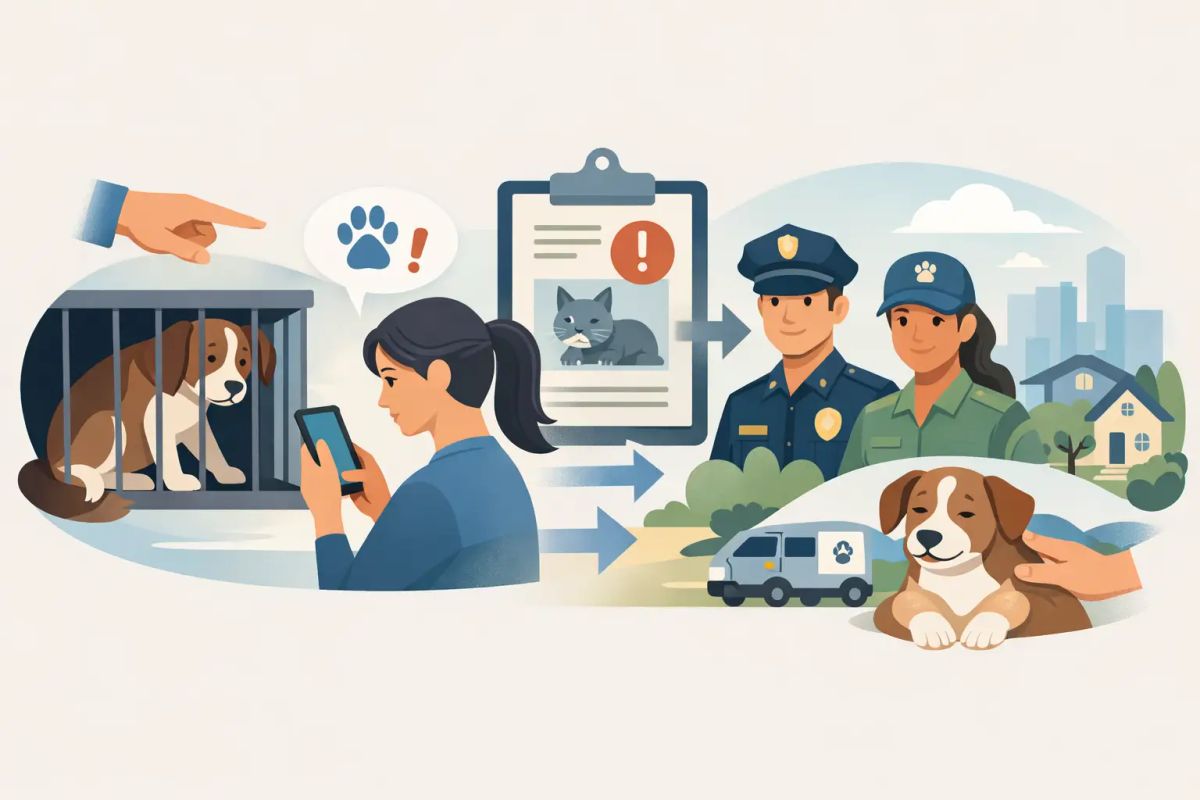
The process typically starts with an initial complaint. That complaint should include the location, the date and time, what was observed, how long the condition has been going on if known, and whether there are photos, video, or other witnesses. If the animal owner is known, that information can help, but it is not always necessary.
After a report is filed, the agency may screen it for urgency and jurisdiction. Some cases receive immediate response. Others are assigned for follow-up, especially when the allegation involves neglect rather than active violence. An officer or investigator may visit the property, observe the animal, speak with the owner, interview witnesses, and document conditions.
What happens next depends on the facts and on the law. Sometimes the owner is given a warning or a compliance order. Sometimes animals are seized. Sometimes a citation or criminal charge follows. And sometimes, frustratingly, a case is closed with little visible action because the evidence does not meet the legal threshold. That does not always mean the report was pointless. A documented complaint can matter later if new evidence emerges or additional reports establish a pattern.
What to include in a report
The strongest reports are factual, specific, and restrained. Anger is understandable. But agencies can act faster on clear facts than on emotional conclusions.
Start with the basics. State the address or exact location. Note the species, number of animals, and identifying details such as breed, size, color, or markings if visible. Describe what you saw. Was the animal limping, bleeding, collapsing, crying out, confined without shade, surrounded by feces, or unable to reach water? If weather is relevant, include it. Heat, freezing temperatures, and exposure can turn neglect into an immediate emergency.
Timing matters. Include when you observed the conditions and whether it has happened more than once. A single observation may raise concern. Repeated observations can establish ongoing neglect. If other people saw the same thing, note that as well.
Photos and video can be valuable, but only if they are obtained lawfully and safely. Do not trespass, provoke confrontation, or put yourself in danger trying to gather evidence. If you can document conditions from a public space or your own property, do so. Keep the original files if possible, with time and date information intact.
What not to do
Do not wait for the perfect case. Delay often helps the abuser, not the animal. If the situation is urgent, report it immediately.
Do not exaggerate. If you did not see a beating, do not claim one. If you do not know whether an injury is recent, say that you do not know. Credibility matters.
Do not assume one agency will pass the complaint to the right place. If you are told to contact another department, make that contact yourself and document who you spoke with.
Do not treat a social media post as a report. Public attention can help in some cases, but it does not replace contacting the proper authority. Online outrage without formal reporting may generate noise and no intervention.
When the first report goes nowhere
This is one of the hardest parts of the animal cruelty reporting process. Many people make a report in good faith, see no visible result, and assume the system has failed completely. Sometimes it has. Sometimes the issue is slower and more complicated than it should be.
If the animal remains in danger, report again with updated facts. Reference the earlier complaint if you have a case number. Ask which agency has jurisdiction and whether additional evidence is needed. Keep a written record of dates, contacts, and observations. That record can become critical if there is a later seizure, prosecution, or public records request.
It also helps to understand the limits of enforcement. An investigator may suspect neglect but still need stronger documentation to take custody of an animal or support charges. That is not a defense of weak response. It is a reminder that persistence and precision matter.
In Nevada and elsewhere, reform-minded advocates have pushed for stronger standards, better enforcement, and more transparency because too many cases stall behind vague thresholds and inconsistent follow-through. Public accountability does not begin after conviction. It begins when agencies know the public is paying attention to how reports are handled.
Anonymous reporting, confidentiality, and retaliation concerns
Many people hesitate to report because they fear retaliation from a neighbor, employer, family member, or landlord. Whether anonymous reporting is accepted depends on the agency. Some accept it. Some prefer named complainants because investigators may need follow-up details.
If safety is a concern, say so when making the report. Ask how your information will be handled. In some cases, your identity may not be disclosed publicly at the initial stage, but records laws and court proceedings can affect confidentiality later. It depends on the agency, the case status, and state law.
This is another reason to be careful and factual. A truthful report made in good faith is not the same as harassment. People should not be intimidated into silence when an animal is suffering.
Why documentation supports reform, not just one case
Every cruelty report serves two possible functions. The first is immediate intervention for the animal at risk. The second is institutional evidence. Patterns in reporting can reveal where enforcement is weak, where certain types of neglect are routinely minimized, and where laws leave too much room for inaction.
That is why public-facing accountability tools matter. A registry, case visibility, and informed civic pressure create consequences beyond a single incident. Nevada Animal Advocates has built its work around that principle: abuse should not disappear into closed files and public forgetfulness.
The reporting process is not just about telling authorities something bad happened. It is about creating a record that systems cannot easily ignore.
A practical standard for deciding whether to report
If you are asking yourself whether the situation is serious enough, use a simple standard: is there a reasonable basis to believe the animal is being harmed, neglected, denied basic care, or placed in immediate danger? If the answer may be yes, make the report.
You are not required to investigate like a prosecutor. You are required, as a member of the public, to respond when suffering is in front of you. That is how accountability begins - not with certainty, but with action backed by facts.
The most helpful thing you can do is often the least dramatic: document carefully, report promptly, follow up when necessary, and refuse to treat cruelty as someone else’s problem.