
A Cross Agency Cruelty Response Example That Works
Published by Nevada Animal Advocates
A cruelty report should not collapse because one office lacks authority, another lacks evidence, and a third never receives the case. That is precisely why a cross agency cruelty response example matters. Animal abuse cases often expose gaps between animal control, law enforcement, prosecutors, social services, veterinary professionals, and community advocates. Those gaps can leave animals in danger, frustrate witnesses, and allow repeat offenders to avoid meaningful consequences.
A coordinated response is not about creating more bureaucracy. It is about making sure each agency performs its legal role, shares lawful and necessary information, and acts quickly enough to protect animals and the public.
What a Cross Agency Cruelty Response Example Looks Like
Consider a report involving several underweight dogs kept in extreme heat behind a residential property. A neighbor has observed the conditions for weeks, hears frequent distress, and sees an animal that appears unable to stand. The neighbor reports the situation to animal control and provides dates, photographs taken from a lawful public vantage point, and a description of the conditions.
Animal control responds and identifies visible concerns: inadequate shade, limited water access, apparent emaciation, and possible untreated injuries. The officer documents the scene, checks for prior calls at the address, and determines that the matter may involve criminal conduct rather than a correctable code violation alone.
At that point, the response cannot stop with a warning and a file number. Animal control contacts law enforcement to assess criminal elements, including neglect, intentional harm, obstruction, or other violations supported by the evidence. If immediate danger is present, officials may seek the legal authority needed to remove animals or obtain access to areas not open to public view.
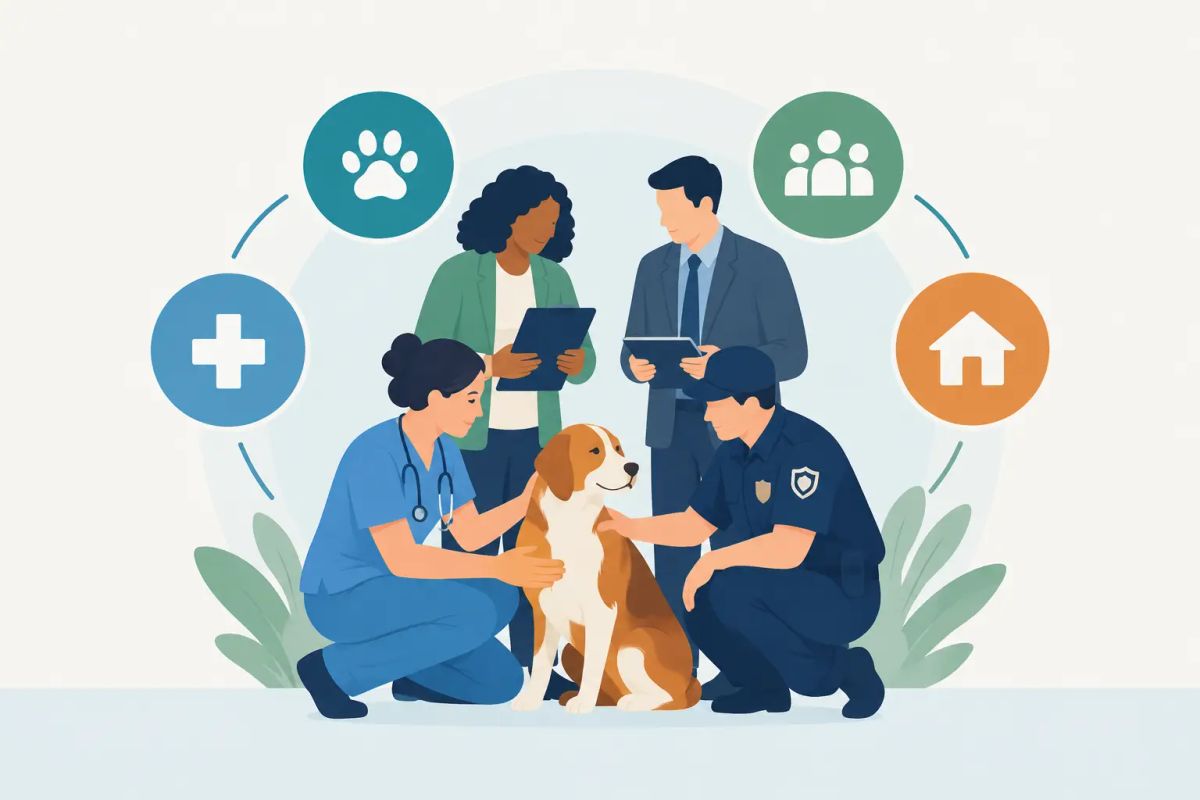
The response expands in a disciplined way. A veterinarian documents body condition, injuries, dehydration, parasites, or other medical findings. Law enforcement preserves photographs, video, witness statements, call histories, and records of prior contact. A prosecutor is consulted early where appropriate, particularly when warrant language, seizure procedures, or charging decisions may affect the strength of the case.
This is coordination with a purpose: protect the animals, preserve admissible evidence, and create a case that can withstand scrutiny.
Every Agency Has a Different Job
Cross-agency work fails when agencies are expected to do work outside their authority or expertise. It succeeds when responsibilities are clear.
Animal control officers are often the first public officials to see conditions on the ground. They can assess welfare concerns, document living environments, identify animals, review licensing or prior complaint history, and take action under local and state authority. Their observations can be central to the case, but they should not be left to carry every investigative and legal burden alone.
Law enforcement brings investigative authority and criminal case experience. Officers can interview suspects and witnesses, investigate related offenses, seek warrants when probable cause exists, and connect animal cruelty with broader public-safety concerns. Animal cruelty is not an isolated issue. It can coexist with domestic violence, child endangerment, weapons offenses, fraud, illegal breeding, and threats against neighbors or witnesses.
Veterinary professionals provide the medical foundation that turns a troubling scene into documented evidence. A statement that an animal looked neglected is far weaker than a clinical assessment explaining weight loss, disease, injury, pain, prolonged deprivation, or the likely consequences of delayed treatment.
Prosecutors need a complete, well-organized case file. That includes reports, photographs, medical records, evidence logs, witness contact information, prior incident records when legally relevant, and a clear chronology. Early communication can prevent avoidable errors, especially in cases involving multiple animals, contested ownership, or emergency seizure decisions.
Advocates and community organizations have a separate but necessary role. They can educate the public on reporting, monitor policy failures, support stronger statutes and enforcement standards, and demand transparency when cases vanish without explanation. They should not interfere with an active investigation, harass accused individuals, or present unverified claims as fact. Public accountability must be grounded in accuracy and due process.
The First 48 Hours Matter
A credible cruelty response depends heavily on what happens immediately after a report. Animals may be moved, evidence may disappear, witnesses may become reluctant, and injuries may worsen. Agencies need a reliable pathway for escalating urgent cases rather than treating every complaint as routine.
The first priority is safety. If an animal appears to be in immediate distress, responders should assess whether emergency intervention is authorized and necessary. If people at the scene are threatening, armed, or suspected of violence, law enforcement support may be required before animal control can safely enter or investigate.
The second priority is documentation. General descriptions are not enough. Investigators should record dates, times, weather conditions, animal locations, available food and water, shelter, physical condition, odors, waste buildup, restraints, visible injuries, and statements made at the scene. Photographs should show both close details and the wider environment so conditions cannot later be misrepresented.
The third priority is preservation. Each animal should be identified accurately. Veterinary examinations, chain-of-custody records, intake records, and written observations should be maintained in a way that supports prosecution. In large-scale cases, this requires planning. Poorly organized evidence can weaken even the most disturbing case.
When a Warning Is Not Enough
Education and voluntary compliance have a place in some welfare cases. A person who misunderstands local shelter requirements or needs short-term access to resources may respond appropriately to clear instruction. But agencies must not use education as a substitute for enforcement when evidence points to serious neglect, repeated violations, intentional cruelty, or immediate danger.
The deciding factor is not whether an owner appears apologetic. It is the condition of the animals, the documented history, the level of risk, and whether the person has the capacity and willingness to correct the harm. Repeat complaints should trigger a closer review, not a cycle of disconnected warnings.
A cross-agency response also helps distinguish between cases that need services and cases that require criminal accountability. Those categories can overlap. An individual may need mental health intervention, housing support, or assistance with animal surrender while still facing consequences for unlawful neglect. Compassion for human hardship cannot mean abandonment of animals suffering in plain sight.
Accountability Continues After the Case Is Filed
Filing charges is not the finish line. Agencies should communicate about court dates, animal custody, restitution, forfeiture proceedings, plea terms, and conditions that may limit future animal ownership where the law permits. A case can lose its public-safety value if a convicted offender quickly acquires more animals without meaningful oversight.
This is where transparent public systems matter. A statewide animal abuse registry, built around reliable and legally appropriate conviction information, can give residents, shelters, rescues, employers, and other stakeholders a clearer picture of documented offenders. It can also expose a larger problem: cruelty cases are often treated as isolated events when patterns of harm are visible only after information is collected and made accessible.
Nevada Animal Advocates supports accountability mechanisms because animal abuse deserves more than temporary attention after a shocking case. Public awareness, enforceable standards, and consequences that follow proven misconduct are essential to prevention.
Building a Response That Does Not Depend on Luck
A workable protocol should establish who receives reports, when law enforcement is notified, how urgent cases are escalated, and who owns the case after animals are removed. It should also set expectations for evidence sharing, prosecutor consultation, veterinary documentation, and follow-up after court action.
But protocols alone are not enough. Agencies need training, staffing, and leadership willing to treat cruelty as a serious offense. A community also needs residents who report what they see promptly, document lawfully, avoid confronting suspected abusers, and continue asking whether institutions acted.
The strongest response is one that makes cruelty harder to hide and harder to repeat. When agencies act together, evidence is preserved, animals have a better chance of survival, and accountability becomes more than a promise.