
What States Have Animal Abuse Registry Laws?
Published by Nevada Animal Advocates
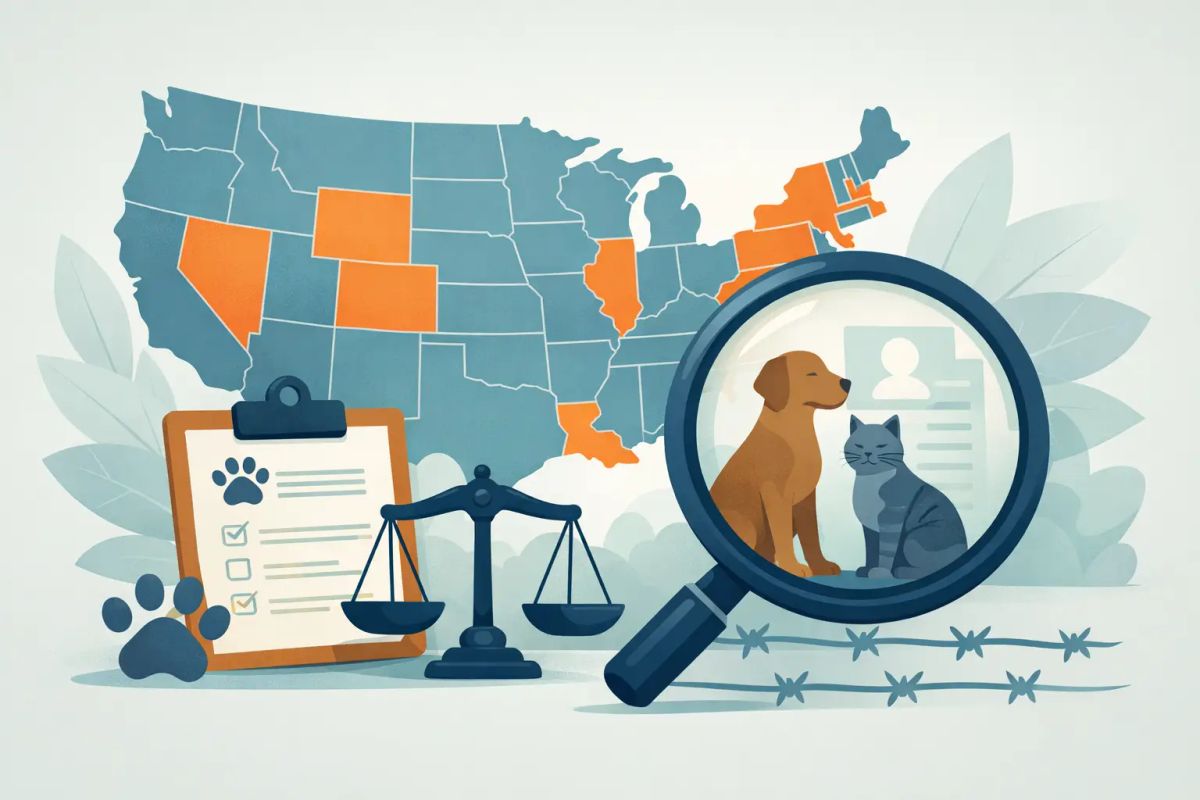
If you are asking what states have animal abuse registry laws, the short answer is: very few. Despite growing public support for stronger consequences for animal cruelty, statewide registries remain the exception, not the rule. That gap matters because animal abuse is not a minor offense. It is a public safety issue, a violence issue, and a clear test of whether a state takes prevention and accountability seriously.
For advocates, journalists, policymakers, and residents trying to protect animals in their communities, this is not just a legal trivia question. A registry can create public visibility around convicted abusers, support informed decision-making, and reinforce the principle that cruelty should carry lasting consequences. But the details vary, and so do the political and legal barriers.
What states have animal abuse registry systems today?
At the statewide level, animal abuse registries are still rare in the United States. Tennessee is often cited as the first state to establish a statewide animal abuser registry. The law created a publicly accessible system listing certain people convicted of animal cruelty offenses for a defined period. That made Tennessee a major reference point in the national debate.
Beyond Tennessee, the landscape becomes less clear because many efforts have happened at the county or local level rather than statewide. Some jurisdictions have proposed registries through legislation but did not pass them. Others adopted limited systems that are not always continuously maintained, broadly publicized, or easy for residents to use.
This is where confusion starts. People search for what states have animal abuse registry programs and find a mix of news coverage, proposed bills, local laws, and outdated references. A bill introduced in a state is not the same as an active registry. A county database is not the same as a statewide public accountability system. And a law on paper is not enough if enforcement is weak or the public cannot practically access the information.
Why so few states have animal abuse registry laws
The lack of registries is not because animal cruelty is rare or unimportant. It is because legislative systems often move slowly, and accountability measures tend to face resistance from people who are more comfortable with minimal consequences.
Some opponents raise civil liberties concerns, especially around public posting, duration of registration, and which offenses qualify. Those questions deserve a serious legal response, but they should not become an excuse for inaction. States already maintain public registries for other categories of conduct when lawmakers decide the public interest is strong enough. The real question is whether animal cruelty is being treated with the urgency it deserves.
Another issue is political will. It takes sustained advocacy to move a registry bill from outrage to statute. Lawmakers may support tougher animal cruelty laws in principle while avoiding more public-facing measures that create visibility and pressure. Registries do exactly that. They make abuse harder to minimize, easier to track, and more likely to remain part of the public record.
There is also an implementation problem. A registry is not meaningful if no agency is clearly responsible for maintaining it, updating entries, verifying compliance, or responding to violations. States may hesitate because they do not want to fund or administer a new system. But that concern should lead to better design, not abandonment.
What an animal abuse registry is supposed to do
A serious registry is not symbolic. It serves a public function.
First, it creates transparency. When a person has been convicted of qualifying animal cruelty offenses, communities should not have to rely on scattered court records or old news reports to understand that history.
Second, it can help prevent repeat harm. Shelters, rescues, breeders, landlords, neighbors, and community members may all have a legitimate interest in knowing whether someone has a documented cruelty conviction. Access to that information can affect placement decisions, monitoring, and risk assessment.
Third, it reinforces accountability. Criminal sentencing happens in a courtroom, but public protection continues after a case closes. A registry signals that cruelty is not a one-time paperwork event. It is conduct with consequences that extend beyond the day of conviction.
That said, not every registry is equally effective. Scope matters. A narrow law that excludes many forms of abuse, limits public access, or imposes weak reporting requirements may exist technically while offering little real protection.
What to look for when evaluating a state registry
When people ask what states have animal abuse registry laws, they often want a list. But the better question is whether a registry actually works.
A credible registry should define which convictions trigger registration, how long a person remains listed, who manages the database, and what happens if someone fails to comply. It should also be reasonably accessible to the public. If ordinary residents cannot find or understand it, the system is not doing its job.
It also matters whether the registry is statewide rather than fragmented across counties. Animal abusers do not stop at jurisdictional lines. A patchwork system creates loopholes, confusion, and uneven protection.
Accuracy matters too. A registry must be updated, legally sound, and limited to verified qualifying cases. Public accountability depends on credibility. If the information is stale or incomplete, critics will use those weaknesses to discredit the entire concept.
The difference between local and statewide registries
Some counties and municipalities have created their own registries, usually through local law. These efforts can fill a gap, especially when states refuse to act. They also prove that public accountability tools are possible.
But local registries are not enough. They vary widely in quality, visibility, and authority. A person listed in one county may move to another area with no practical tracking. Residents may not even know a local registry exists unless they already follow animal policy closely.
Statewide systems are stronger because they create consistent rules and broader access. They send a clearer message that animal cruelty is not a local nuisance issue. It is a matter of statewide public concern.
That is one reason advocacy in Nevada matters. A statewide registry model is not about symbolism. It is about creating durable public infrastructure for accountability and abuse prevention, especially in a state that needs stronger systemic tools rather than scattered responses.
Why this question matters beyond animal welfare
Animal cruelty rarely exists in isolation. Research and law enforcement experience have long pointed to connections between abuse of animals and other forms of violence, including domestic abuse and child maltreatment. That does not mean every offender presents the same risk profile, but it does mean cruelty should never be dismissed as a private matter or a low-level offense.
A registry can help communities take that reality seriously. It gives journalists better visibility into patterns. It gives advocates a factual basis for reform. It gives policymakers a mechanism that is concrete, not rhetorical. And it gives the public access to information that can influence community safety decisions.
There are trade-offs, as with any legal tool. Registry laws must be carefully written to avoid overbreadth, protect due process, and define qualifying offenses clearly. But none of those drafting challenges are a reason to maintain the status quo. Weak systems can be fixed. No system at all leaves animals and communities exposed.
So, what states have animal abuse registry laws?
If you want the plainest answer, Tennessee is the clearest statewide example historically recognized in the United States. Beyond that, many states have considered registry bills, and some local governments have adopted versions of their own, but the number of active, statewide, publicly accessible registries remains extremely limited.
That scarcity should not be read as proof that registries are unnecessary. It should be read as proof that legislative reform has not kept pace with the seriousness of the problem. Animal cruelty continues. Public demand for transparency continues. The policy need is still there.
For Nevada residents and anyone tracking reform nationally, the real issue is not whether a handful of states have acted. It is why so many still have not. A society that claims to value humane treatment should be willing to build systems that identify convicted abusers, support prevention, and make accountability visible.
The next step is not waiting for another state to become a headline. It is insisting that lawmakers treat animal cruelty as conduct serious enough to track, serious enough to expose, and serious enough to prevent.