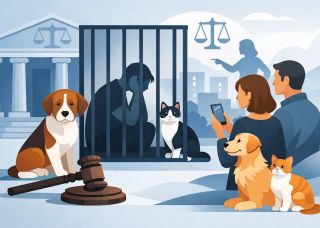
Why Abuse Offender Transparency Laws Matter
Published by Nevada Animal Advocates

A person convicted of animal cruelty should not disappear back into public life without scrutiny. That is the basic principle behind abuse offender transparency laws. When the legal system confirms that someone has abused an animal, the public has a legitimate interest in knowing that history, especially when future animals, rescues, shelters, landlords, employers, and neighbors may be affected.
These laws are not about spectacle. They are about accountability. They recognize that animal abuse is not a private mistake with no wider consequences. It is conduct that signals danger, raises serious welfare concerns, and often exposes larger failures in enforcement. Transparency does not replace prosecution, sentencing, or rehabilitation. It makes those systems harder to ignore and easier for the public to evaluate.
What abuse offender transparency laws actually do
At their core, abuse offender transparency laws make verified information about certain abuse convictions accessible to the public. The exact structure varies by state or jurisdiction. Some laws create public registries. Others require reporting mechanisms, disclosure rules, or publication of offender information after conviction.
The key distinction is that these laws are tied to adjudicated misconduct, not rumor. That matters. A transparency system should be built around confirmed cases, clear legal standards, and defined procedures for inclusion and removal. Without those safeguards, the policy becomes vulnerable to challenge and less credible to the public.
When designed well, these laws serve several functions at once. They warn the community, support due diligence by animal-related organizations, and create pressure for consistent enforcement. They also tell a broader truth that many institutions still resist: animal cruelty is not minor, and public policy should stop treating it that way.
Why abuse offender transparency laws matter beyond one case
A cruelty conviction is often discussed as if it begins and ends in a courtroom. Real life does not work that way. After a case closes, people still make decisions about who can adopt, foster, breed, board, transport, or live with animals. Rescues still screen applicants. Shelters still weigh risk. Communities still want to know whether local systems take abuse seriously.
That is where abuse offender transparency laws have practical value. They give the public a factual tool instead of forcing organizations and residents to rely on fragmented records, word of mouth, or media coverage that may disappear after the first headlines. In many places, the problem is not that abuse never reaches the legal system. The problem is that once it does, the information becomes scattered, difficult to access, or functionally invisible.
Transparency also changes incentives. When convictions are easier to find, prosecutors, law enforcement agencies, and courts know the public can track outcomes. That visibility can strengthen trust, but it can also expose weak charging decisions, lenient treatment, or repeated failures to intervene. For reform advocates, that is not a side effect. It is part of the point.
Public accountability is not the same as public shaming
Critics sometimes frame transparency laws as punitive theater. That argument misses a central issue. Public accountability after a lawful conviction is not the same thing as mob justice. A well-constructed transparency law does not invite speculation. It publishes limited, relevant facts tied to a formal legal process.
That difference matters because opponents often try to shift the conversation away from victims and onto offender discomfort. But discomfort is not the standard. Public interest is. If someone has been convicted of abusing an animal, the public interest in preventing future harm is real, and it does not vanish because disclosure may be unwelcome.
At the same time, serious policy requires boundaries. Transparency laws should be accurate, updated, and tied to convictions or other clearly defined findings. They should include procedures for correcting errors. In some jurisdictions, lawmakers may choose time limits, offense thresholds, or distinctions between misdemeanor and felony conduct. Those details are worth debating. The basic principle is not.
Where these laws help most
The strongest case for transparency often appears in ordinary gatekeeping decisions. Animal rescues and shelters need reliable screening tools. Property owners may want to know whether a tenant seeking to keep animals has a documented cruelty history. Employers in animal care settings may need better information when hiring. Neighbors and community members may use public records to monitor repeat concerns and report violations faster.
Transparency can also help journalists and advocates identify patterns that would otherwise stay hidden. Are certain jurisdictions undercharging severe abuse? Are repeat offenders receiving access to animals again and again? Are sentencing conditions being monitored at all? Without accessible records, those questions are harder to answer and easier for institutions to avoid.
In Nevada, where public accountability around animal cruelty remains an urgent issue, these questions are not abstract. They shape whether prevention is taken seriously or left to chance. Nevada Animal Advocates has pushed this issue into public view because awareness alone is not enough. Communities need infrastructure for accountability, not just outrage after the fact.
The policy trade-offs are real, but manageable
Any serious conversation about abuse offender transparency laws has to address trade-offs. One concern is overbreadth. If a law is too vague, too sweeping, or disconnected from verified case outcomes, it can undermine trust and invite legal problems. Another concern is uneven enforcement. A registry or disclosure law is only as credible as the cases that make it into the system.
There is also the question of duration. How long should information remain public? Reasonable people can disagree. Some will argue for permanent access in serious cases, especially where torture, death, organized cruelty, or repeat offending is involved. Others may support a time-limited model for lower-level offenses if strict compliance and no reoffending can be shown. That is a policy design question, not a reason to reject transparency altogether.
Privacy objections also surface often, but they should be weighed honestly. A criminal conviction is already a matter of public record. Transparency laws do not invent that fact. They make it accessible in a way that serves prevention. The real policy question is whether the state should leave crucial safety information buried in systems most people cannot realistically search.
What strong abuse offender transparency laws should include
A credible law starts with clarity. It should define which offenses trigger disclosure, what information is published, who maintains the records, and how updates happen. It should also establish a process for correcting mistakes quickly. Accuracy is not optional in any public accountability system.
Strong laws should be paired with enforcement mechanisms, not passed as symbolic gestures. If courts order restrictions on animal ownership, there must be a way to monitor compliance. If agencies are required to report convictions, there must be consequences for failing to do so. A law that exists on paper but disappears in practice does little for animals and even less for public trust.
Good policy also respects the difference between access and misuse. Public information should serve legitimate safety and accountability interests. That means lawmakers should think carefully about scope and administration, while refusing the false claim that the only choices are secrecy or chaos.
Why this debate reflects a bigger moral test
Animal cruelty policy reveals what a legal system is willing to dismiss. When abuse is hidden, minimized, or treated as a one-off incident with no civic relevance, the message is clear: institutional convenience matters more than prevention. Abuse offender transparency laws challenge that pattern by saying the public has a right to know when cruelty has been proven and a right to demand better from the systems meant to respond.
That is why these laws matter even to people who are not immersed in advocacy work. They set a standard for whether accountability is real, whether enforcement can be tracked, and whether animals are protected before another case becomes a headline. A society that claims to oppose cruelty should be willing to make cruelty convictions visible.
The most useful reform is not the one that sounds toughest. It is the one that makes future harm harder to hide.