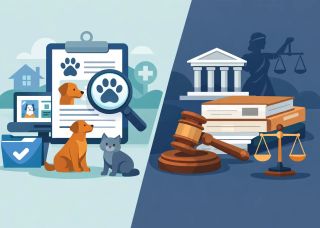
Criminal Registry vs Court Docket: Key Differences
Published by Nevada Animal Advocates

A court case can be public without being understandable. That gap matters when communities are trying to assess animal cruelty, report concerns, or demand action from public officials. The distinction between a criminal registry vs court docket is not a technicality. It determines whether the public can find meaningful accountability information or must piece together a case from fragmented legal records.
For animal welfare advocates, the question is straightforward: Does a record merely show that a case moved through court, or does it provide clear, verified information about an offender and the outcome? Those are very different public functions.
Criminal Registry vs Court Docket: What Each One Does
A court docket is the court's running record of a case. It generally identifies the court, case number, parties, filings, hearing dates, charges, motions, judicial orders, and final disposition. Think of it as the procedural timeline of what happened in a legal case.
A criminal registry, by contrast, is a curated database of people who meet defined eligibility criteria, often following a conviction or other verified legal finding. A registry is designed for public awareness and accountability. It can organize information that is otherwise difficult for residents to locate, interpret, or compare across jurisdictions.
The difference is purpose. A docket exists to document court activity. A registry exists to make specific, verified public-safety information accessible and usable.
That distinction is especially relevant in animal cruelty cases. A concerned neighbor should not have to understand court abbreviations, search multiple case systems, or decipher whether a charge was reduced or dismissed just to learn whether someone has been convicted of abusing animals.
A Court Docket Is Not a Finding of Guilt
A docket may list serious allegations, but an allegation is not a conviction. A criminal case can end in many ways: dismissal, acquittal, diversion, a plea to a different offense, a conviction, or a sentence that includes probation and restrictions on animal ownership.
This is why reading a docket requires care. The initial charge may be alarming, but the final outcome is what establishes the legal result. A docket can also contain incomplete language, administrative entries, continuances, and filings that mean little to someone without legal experience.
Public accountability must be accurate. Publishing or repeating an accusation as though it were a proven fact can harm due process, mislead the community, and weaken the credibility of animal protection efforts. A responsible registry should rely on clear standards, verified records, and transparent inclusion criteria.
That does not mean the public should ignore pending cases. Pending cruelty prosecutions can reveal where enforcement, charging practices, or court delays deserve scrutiny. But pending-case reporting and a conviction-based registry serve different purposes and should be labeled clearly.
What a Registry Can Make Visible
A well-designed animal abuse registry can turn scattered public records into a resource people can actually use. Rather than forcing the public to search court by court, it can identify qualifying offenders and present the information in plain language.
Depending on the governing rules and available verified records, a registry may include the person's name, offense, jurisdiction, date of conviction, sentence, animal-ownership restrictions, and status of any appeal or record-sealing change. It should also explain its data standards and provide a process for correcting factual errors.
That structure matters because animal cruelty rarely affects only one victim or one household. People who abuse animals may move, adopt or acquire new animals, work in animal-facing settings, or return to environments where vulnerable animals remain at risk. Public awareness can help rescues, shelters, landlords, employers, neighbors, and prospective adopters make informed decisions within the law.
A registry is not a substitute for law enforcement, prosecution, or the courts. It cannot investigate crimes, impose a sentence, or determine guilt. Its role is different: visibility. When verified outcomes disappear into inaccessible court systems, repeat risks can remain hidden from the people trying to prevent future harm.
Why Dockets Alone Fall Short for Animal Protection
Court records are essential, but they were not built as an animal welfare prevention tool. Access varies by court and jurisdiction. Search functions can be limited. Names may be misspelled or common. Some records may require an in-person request, a fee, or knowledge of the case number. Sealed records are not available to the general public.
Even when a docket is easy to locate, it may not answer the questions residents actually have. Was there a conviction? What conduct was proven? Did the court prohibit animal ownership? Has the restriction expired? Was the case resolved under another charge?
The burden should not fall on every resident to become a records researcher. Public systems should be understandable enough for communities to recognize documented risk and hold institutions accountable for how cruelty cases are handled.
This is also why animal cruelty data matters beyond individual cases. If a county repeatedly reduces serious charges, fails to seek animal-ownership bans, or leaves cases unresolved for long periods, court dockets may contain the evidence. But identifying the pattern requires organization, comparison, and sustained public attention.
Due Process Must Be Part of Accountability
Animal advocates can demand stronger consequences without abandoning fairness. In fact, accuracy strengthens the case for reform.
A credible registry should distinguish between charges, convictions, and dismissed cases. It should not imply that a person is guilty simply because they were arrested or named in a complaint. It should use reliable source records, state the basis for inclusion, and update entries when a conviction is overturned, a record is sealed, or the underlying information changes.
The same standard applies to public discussion. Advocates should describe a case precisely: charged, convicted, sentenced, dismissed, pending, or appealed. That discipline protects the integrity of the movement and keeps the focus where it belongs: verified accountability for cruelty.
In Nevada, as elsewhere, legal records can be affected by privacy rules, record-sealing orders, appellate decisions, and differences among courts. A registry must respect those limits. Transparency is not permission to publish every accusation forever. It is a commitment to sharing accurate, lawfully available information that serves a defined public-interest purpose.
How Residents Can Use Both Records Responsibly
The most effective approach is not choosing one resource over the other. It is understanding what each can tell you.
Use a court docket when you need to follow an active case, verify a hearing date, review the procedural history, or determine the final court disposition. If a case is pending, remember that the defendant has not been convicted unless and until a court enters a qualifying judgment.
Use a verified registry when you need a clear, organized view of people who meet established criteria for inclusion. This can be particularly valuable for animal welfare organizations, rescue partners, and community members seeking to avoid placing animals in dangerous situations.
If you find a concerning case, do not use social media speculation as a substitute for reporting. Document what you can lawfully observe and report suspected cruelty to the appropriate law enforcement agency or animal control authority. If the concern involves a current court case, public attendance at hearings and respectful outreach to elected officials can also reinforce that the community is paying attention.
The Policy Question Behind the Records
The debate over a criminal registry vs court docket is ultimately a debate about whether public records are serving the public. A record that exists but cannot be found, understood, or connected to prevention efforts offers limited protection to vulnerable animals.
Nevada Animal Advocates supports accountability mechanisms that make verified animal cruelty outcomes visible while respecting due process. A statewide approach can also expose gaps that are easy to miss when cases are scattered across local court systems: inconsistent penalties, weak ownership restrictions, repeat offenses, and uneven enforcement.
No registry can prevent cruelty on its own. Prevention also requires strong investigation, meaningful prosecution, appropriate sentencing, cross-agency coordination, and laws that treat animal abuse with the seriousness it deserves. But transparency gives residents something essential: the ability to see whether the system is responding or failing.
When an animal cruelty case enters court, follow the docket for the facts of that case. When a verified registry identifies a qualifying offender, use that information carefully and lawfully. Then keep asking the question that drives real reform: what will prevent the next animal from being harmed?